
October 8 colloquium: Geometry and heterogeneity in biological imaging
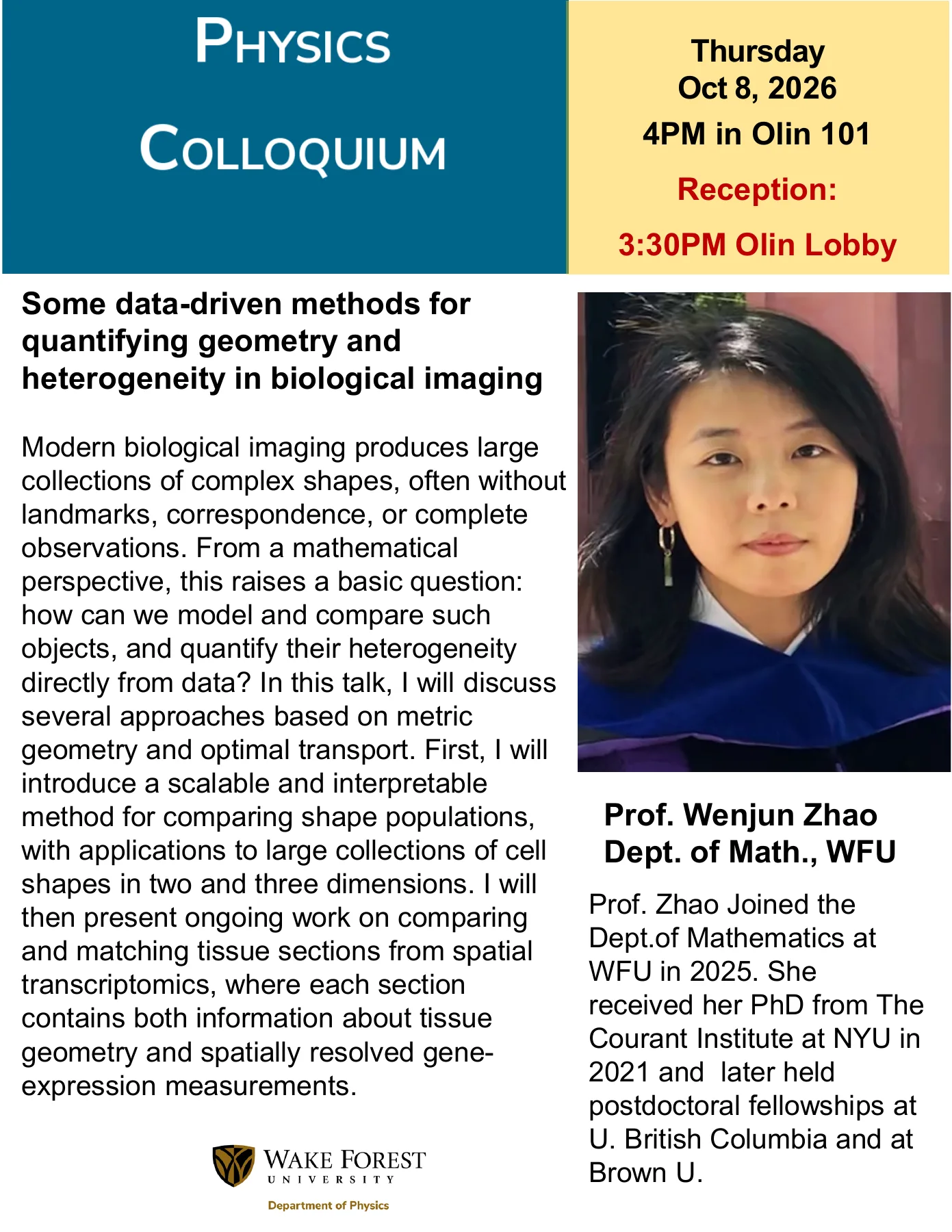
Prof. Wenjun Zhao of Wake Forest University’s Department of Mathematics will present “Some data-driven methods for quantifying geometry and heterogeneity in biological imaging” at the Physics Colloquium on Thursday, October 8, 2026, at 4 p.m. in Olin 101. A reception will precede the talk at 3:30 p.m. in the Olin Lobby.
Zhao will discuss mathematical methods for comparing the complex shapes found in biological images. Using metric geometry and optimal transport, she will describe an interpretable method for comparing populations of cell shapes in two and three dimensions. She will also present ongoing work on matching tissue sections that combine tissue geometry with measurements of gene expression across the tissue.
Speaker’s abstract
Modern biological imaging produces large collections of complex shapes, often without landmarks, correspondence, or complete observations. From a mathematical perspective, this raises a basic question: how can we model and compare such objects, and quantify their heterogeneity directly from data? In this talk, I will discuss several approaches based on metric geometry and optimal transport. First, I will introduce a scalable and interpretable method for comparing shape populations, with applications to large collections of cell shapes in two and three dimensions. I will then present ongoing work on comparing and matching tissue sections from spatial transcriptomics, where each section contains both information about tissue geometry and spatially resolved gene-expression measurements.