
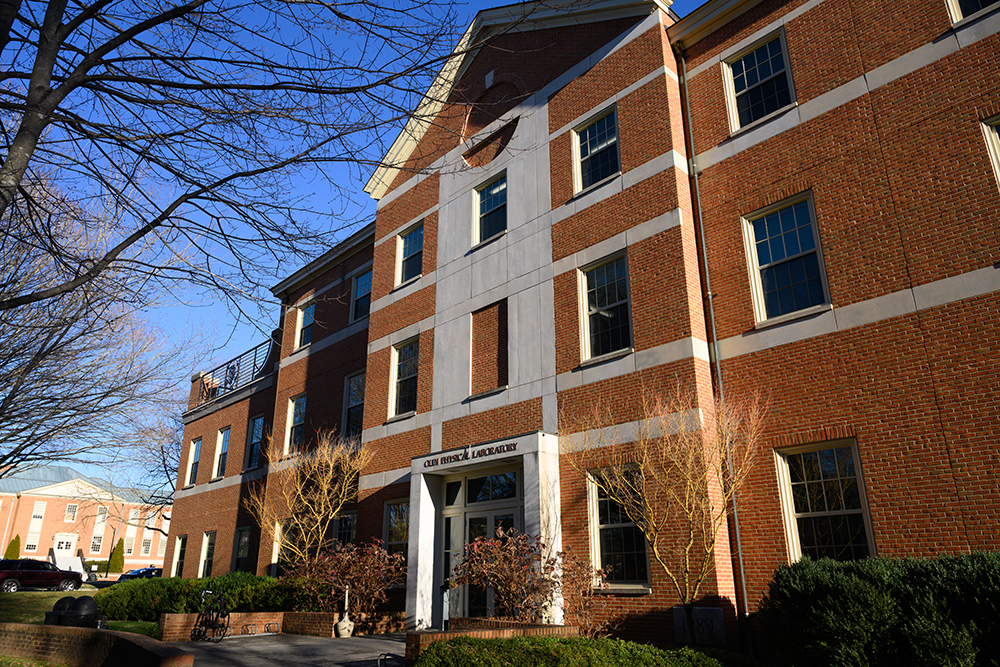
Physics research at Wake Forest uses laboratories in Olin Physical Laboratory, facilities at the Center for Nanotechnology and Quantum Materials, and the university’s DEAC computing cluster. Students and faculty have access to equipment for spectroscopy, microscopy, materials preparation, thin-film deposition, biophysical measurements, and computational research.
Specialized Laboratory Equipment
Specialized facilities and equipment include:
This includes a subpicosecond amplified Ti:sapphire laser, optical parametric amplifier, delay lines, optical multichannel analyzer, and streak camera for time- resolved studies.
Facilities include a thin-film physical vapor deposition (PVD) instrument which is capable of accurately depositing layers of materials ranging from metals, to organic solids, and oxides. This instrument is available for use by all WFU students, faculty and staff.
Thin-Film Physical Vapor Deposition System
The Thin-Film Physical Vapor Deposition (PVD) instrument located in Olin 209 is capable of accurately depositing layers of materials ranging from metals, to organic solids, and oxides. The instrument has a central e-beam evaporator in which up to 4 different target materials may be loaded and sequentially evaporated via a pre-defined, computer-controlled recipe. The e-beam allows for fine control ranging from very rapid deposition rates (up to 410 Å/sec) to slower rates of around 1 Å/sec. Continuous and uniform films as thin as 3 nm can be deposited using this method.
In addition, the system includes two thermal evaporators in which resistive element heating evaporates the user-loaded base materials. Both metals and oxides can be successfully evaporated using the thermal evaporators. Also here, the rate of deposition can be accurately controlled.
The instrument also contains two low-temperature evaporators (LTEs) that are particularly useful in depositing organic materials or other materials with lower sublimation temperature. The LTEs are loaded with the base powder and can either sequentially evaporate or both at the same time for a co-deposition, each at independent rates as desired.
The evaporation chamber is accessible via a hinged door in the rear of the machine, which opens to the lab or by a sliding door on the inside of the attached glovebox. With the glovebox, it is possible to conduct sample preparation in an inert, nitrogen environment and load the sample to be coated without exposing it to atmosphere. After it is loaded and the door closed, the process is entirely controlled by user-defined recipes through a touch-screen computer interface. A cryo-pump evacuates the chamber down to base pressures of 10-7 to 10-8 torr within less than two hours. Once the base pressure is reached, the evaporation can be automated with desired thickness, rate, and material properties as defined by the user. Four crystal monitors are arranged within the chamber to measure the rate and accumulated thickness, which are used in the PID controlled feedback loop.
The instrument is accessible to all WFU students, faculty and staff. For more information, please contact Professor Oana Jurchescu at .
Various equipment is also available for spectroscopy on biological and other samples. These include a Bruker EMX electron paramagnetic resonance (EPR) spectrometer capable of measuring samples at room and low (down to 4 K) temperatures, an OLIS RSM spectrometer capable of millisecond time resolved absorption, scattering and fluorescent measurements as well as freeze-quench capabilities for EPR, and a Cary 100 spectrometer with a multiple cell exchanger and integrating sphere for spectroscopy of turbid samples.
Equipment that is used to analyze blood and other tissue samples includes a hemox analyzer to measure oxygen saturation curves of hemoglobin, and a laser-assisted ektacytometer to measure red blood cell deformability and fragility. There are also instruments to measure nitrite, nitrate and other NO congeners; an EICOM ENO 20 and a Sievers NOAi.
The biophysical research laboratories include equipment such as vibration isolation tables (Halcyonics), a UV-ozone surface cleaner (Samco), and standard molecular biology equipment such as miscellaneous PCR cyclers, centrifuges, incubators, shakers, hoods, pH meters, freezers, refrigerators, electrophoresis apparatuses, gel documentation equipment (e.g., transilluminator and cameras), chemical cabinets, balances, heater/stirrers, nano-pure water, -80˚C and -20˚C freezers and refrigerators, and electrospinning equipment (glove box, power supplies, syringe pumps, mandrels, vacuum pumps, lab jacks) is set up next to a ventilation hood.
Additionally, cell culture facilities include 2 liquid nitrogen cell repositories (MVE Cryogenics and Fisher Scientific Cryoplus); a Nikon Eclipse Ti; nano-pure water, an autoclave; a french press; an HPLC-MS; a Bio-Rad BioLogic DuoFlow QuadTech combination FPLC/HPLC and a BioLogic HR FPLC; a Beckman Coulter LS 6500 scintillation counter; an Aviv 215 Circular Dichroism spectrometer; a Bio-Rad FX-ProPlus Molecular Imager; a BioRad 583 gel dryer; a Bio-Rad ChemiDoc XRS CCD Imaging system; a Kodak EDAS 290 gel documentation system; a Bellco Tissue Culture incubator; a Labconco 4-ft laminar flow hood; an Olympus IMT-2 inverted microscope, liquid nitrogen, and any common solvent/reagents.
A significant amount of Biophysics research and Optics uses optical and AFM microscopes.
A. Optical Microscopes
- Nikon Eclipse E600FN upright with DIC, fluorescence, and brightfield capabilities.
- Olympus IX-71 inverted microscope with brightfield, dark field, and fluorescence capabilities, as well as optical tweezers.
- Olympus BM60 metallurgical microscope for viewing non transmissive samples.
- Nikon inverted microscope – with fluorescence, DIC, a low-noise scientific CMOS camera, environmental chamber (T, CO2), computerized shutter.
- Zeiss Axiovert 200 inverted microscope with brightfield, fluorescence and with a low-noise Hammamatsu emCCD camera or Zeiss AxioCam MRm camera.
- Zeiss Observer D inverted microscope with fluorescence, DIC, and with an environmental chamber.
- Zeiss LSM 710 Laser scanning confocal microscope within the Microscope Imaging Core Facility and Confocal Microscopy Center

- Zeiss LSM 880 with Airyscan – laser scanning confocal microscope within the Microscope Imaging Core Facility and Confocal Microscopy Center – located at Wake Downtown.
B. Atomic Force Microscopes
- Two Topometrix Explorer AFMs (Veeco), which can be controlled (haptic and 3D visual) by two nanoManipulators (3rd Tech)
- Nanoscope III Atomic Force Microscope (Veeco).
- Asylum MFP-3D Bio AFM combined with an Olympus IX73 inverted optical microscope.
Center for Nanotechnology and Quantum Materials at Wake Forest University
The Center for Nanotechnology and Quantum Materials (NANOTEQ) is located adjacent to the Reynolda Campus of Wake Forest University 501 Deacon Blvd., NANOTEQ offers over 6000 sq. ft. of dedicated lab space. Facilities include a electron microscopy and materials characterization facility (HRTEM, FE-SEM, CTEM, STM/AFM, XPS, Scanning Auger, EDAX), a cleanroom facility (Class 1000, sputter deposit, PECVD, thermal evap, and organic device fab.), a solar testing facility (AM1.5g Class A standards vertically and laterally mounted, EQE, IQCE, power efficiency.), and a growth and synthesis lab (anything from CVD to polymer synthesis can be worked out here)
Wake Forest University DEAC Linux Cluster
The Wake Forest University (WFU) Distributed Environment for Academic Computing Cluster (DEAC Cluster) is available to WFU faculty, staff, and students. The DEAC Cluster’s primary mission is to provide a stable, robust, and accessible computational resource that allows the education and research communities to focus on their primary missions.