
Wake Forest astrophysicists study black holes, gravitational waves, compact-object binaries, particle physics, and tests of general relativity. Their work combines theory, numerical simulations, observations, and high-performance computing to investigate some of the universe’s most extreme systems.
SCHOLARSHIP
Faculty working in Astrophysics

Eric D. Carlson
Associate Professor of Physics
Gravitation and Particle Physics
Particle physics and astrophysics
306 Olin Physical Laboratory

Greg Cook
Associate Professor of Physics and ZSR Foundation Fellow
Gravitation and Particle Physics
Theoretical and computational general relativity, gravitational waves produced by black-hole and neutron-star binaries, and high-accuracy modeling of black holes
304 Olin Physical Laboratory
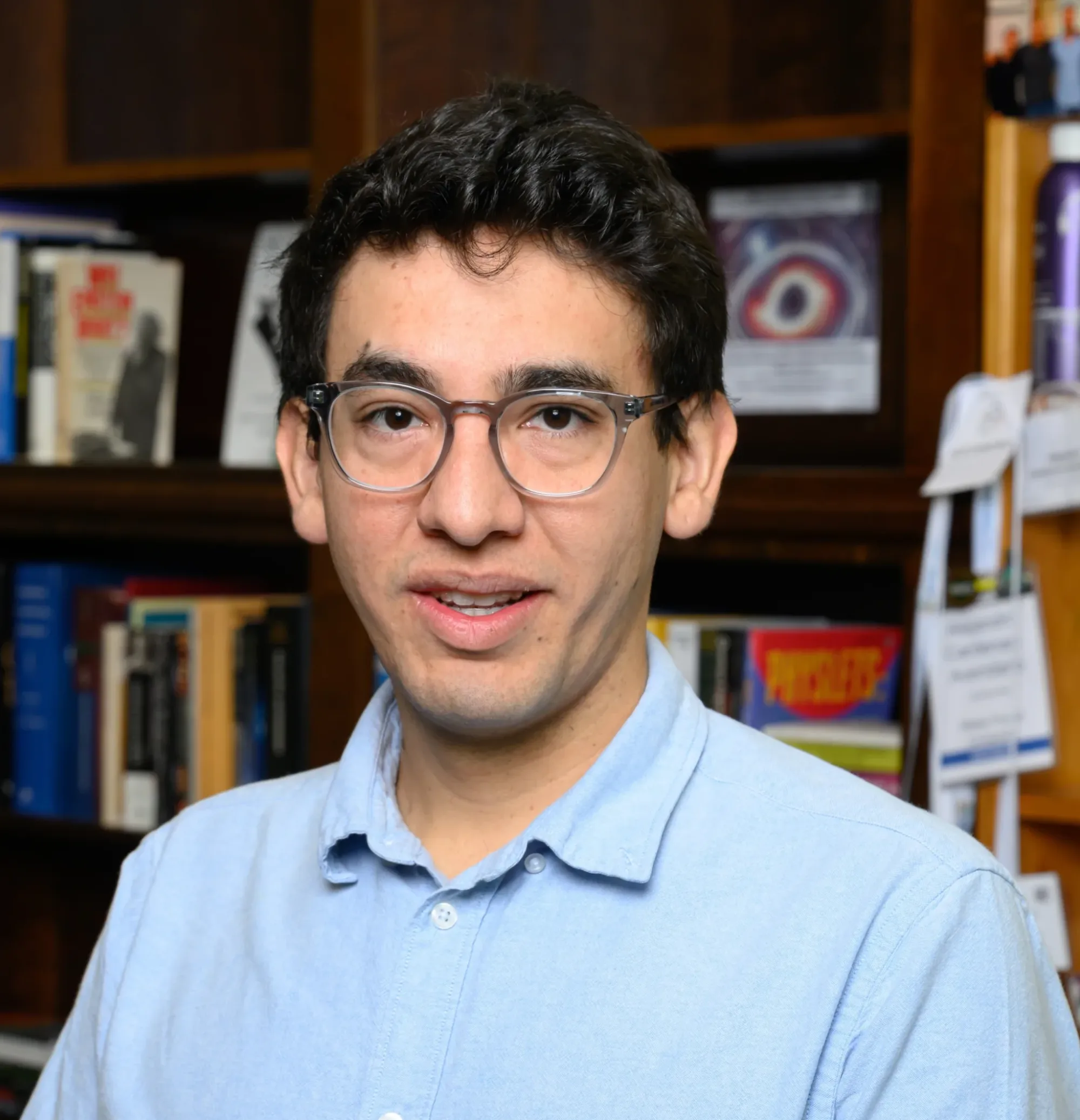
Alejandro Cárdenas-Avendaño
Assistant Professor of Physics
Astrophysics
Theoretical and computational astrophysics.
300 Olin Physical Laboratory

Caitlin Witt
Assistant Professor of Physics
Gravitation and Particle Physics
Supermassive black hole binaries, gravitational waves, pulsars, active galactic nuclei, and computational astrophysics
305A Olin Physical Laboratory
Eric Carlson
Eric Carlson’s research covers a variety of topics including both particle phenomenology and astrophysics. These topics include pseudoscalar couplings, the existence of a naturally small cosmological constant, and neutrino physics. Carlson believes astroparticle physics to be one of the most promising areas in particle phenomenology in the next decade or two

Accepting graduate students

Accepting undergraduate students
Greg Cook
Greg Cook’s research interests are in the areas of computational astrophysics and gravitational physics. Currently, his research is centered on studying the coalescence of compact binary systems. Cook and his collaborators are developing the theoretical and computational tools needed to simulate the collision and coalescence of a pair of black holes.
Accepting graduate students
Accepting undergraduate students
Alejandro Cárdenas-Avendaño
Alejandro Cárdenas-Avendaño’s research explores gravity’s fundamental properties through the gravitational and electromagnetic signals from compact objects like black holes and neutron stars. By combining numerical simulations, theoretical modeling, and data analysis, his group studies phenomena ranging from gravitational waveform signatures to black hole photon rings.
Accepting graduate students
Accepting undergraduate students
Caitlin Witt
Caitlin Witt’s research interests are in the areas of observational and computational astrophysics. Her research centers on supermassive black hole binaries using multimessenger astrophysics, where she combines electromagnetic and gravitational-wave data. Witt and her collaborators use pulsars to search for decades-long gravitational wave signals, time-domain optical surveys to search for binaries, and supercomputers to analyze the data to provide a complete picture of the aftermath of galaxy mergers.
Accepting graduate students
Accepting undergraduate students
Recent Publications in Astrophysics
- Bécsy, B., Cornish, N. J., Petrov, P., Siemens, X., Taylor, S. R., Vigeland, S. J., & Witt, C. A. (2025). Towards robust gravitational wave detections from individual supermassive black hole binaries. Classical and Quantum Gravity, 42(17), 175016. https://doi.org/10.1088/1361-6382/adfd36
- Gao, L., Cook, G. B., Kidder, L. E., Pfeiffer, H. P., Scheel, M. A., Deppe, N., Throwe, W., Vu, N. L., Nelli, K. C., Moxon, J., & Boyle, M. (2025). Robustness of extracting quasinormal mode information from black hole merger simulations. Physical Review D, 112(2). https://doi.org/10.1103/3jj6-jc8q
- Keeble, L. S., & Cárdenas-Avendaño, A. (2025). Estimating high-order time derivatives of Kerr orbital functionals. Physical Review D, 112(8). https://doi.org/10.1103/g26m-mz4v
- Magaña Zertuche, L., Gao, L., Finch, E., & Cook, G. B. (2025). Multimode ringdown modeling with qnmfits and KerrRingdown. Classical and Quantum Gravity, 42(19), 197001. https://doi.org/10.1088/1361-6382/ae0233
- Motta, P. N., Prather, B. S., & Cárdenas-Avendaño, A. (2025). Jipole: A Differentiable ipole-based Code for Radiative Transfer in Curved Spacetimes. The Astrophysical Journal, 995(1), 56. https://doi.org/10.3847/1538-4357/ae16a0
- Sardesai, S. C., Freedman, G. E., Vigeland, S. J., & Witt, C. A. (2025). Optimal strategies for continuous wave detection in pulsar timing arrays: Realistic pulsar noise and a gravitational wave background. arXiv. https://doi.org/10.48550/arXiv.2511.01919
- Siggia, V. R., & Carlson, E. D. (2025). Comparison of f(R,T) gravity with type Ia supernovae data. Physical Review D, 111(2). https://doi.org/10.1103/physrevd.111.024074
- Siggia, V. R., Carlson, E. D., & Pryor, P. L. (2025). Exploration of Parameters in f(R,T) Gravity and Comparison with Type Ia Supernovae Data. arXiv. https://doi.org/10.48550/arXiv.2508.15014