
Ramesh Dhakal Awarded Caltech Presidential Postdoctoral Fellowship
Dr. Ramesh Dhakal, who earned his PhD in Physics this spring, was awarded the prestigious Caltech Presidential Postdoctoral Fellowship. Dhakal recently defended his dissertation, “Modeling Excitations in Quantum Magnets,” and will join the Department of Engineering and Applied Physics at California Institute of Technology this summer, where he will continue research in theoretical materials physics. The Caltech Presidential Postdoctoral Fellowship is awarded to promising early-career researchers pursuing innovative work across science and engineering disciplines. For Dhakal, the fellowship represents both recognition of his research accomplishments and an opportunity to pursue new independent directions in condensed matter physics.
Dhakal’s doctoral research focused on developing theoretical models describing excitations in quantum magnets and connecting those models with experimental observations. His work explored how magnetic excitations interact within complex materials, helping researchers better understand behaviors that emerge at the quantum level.
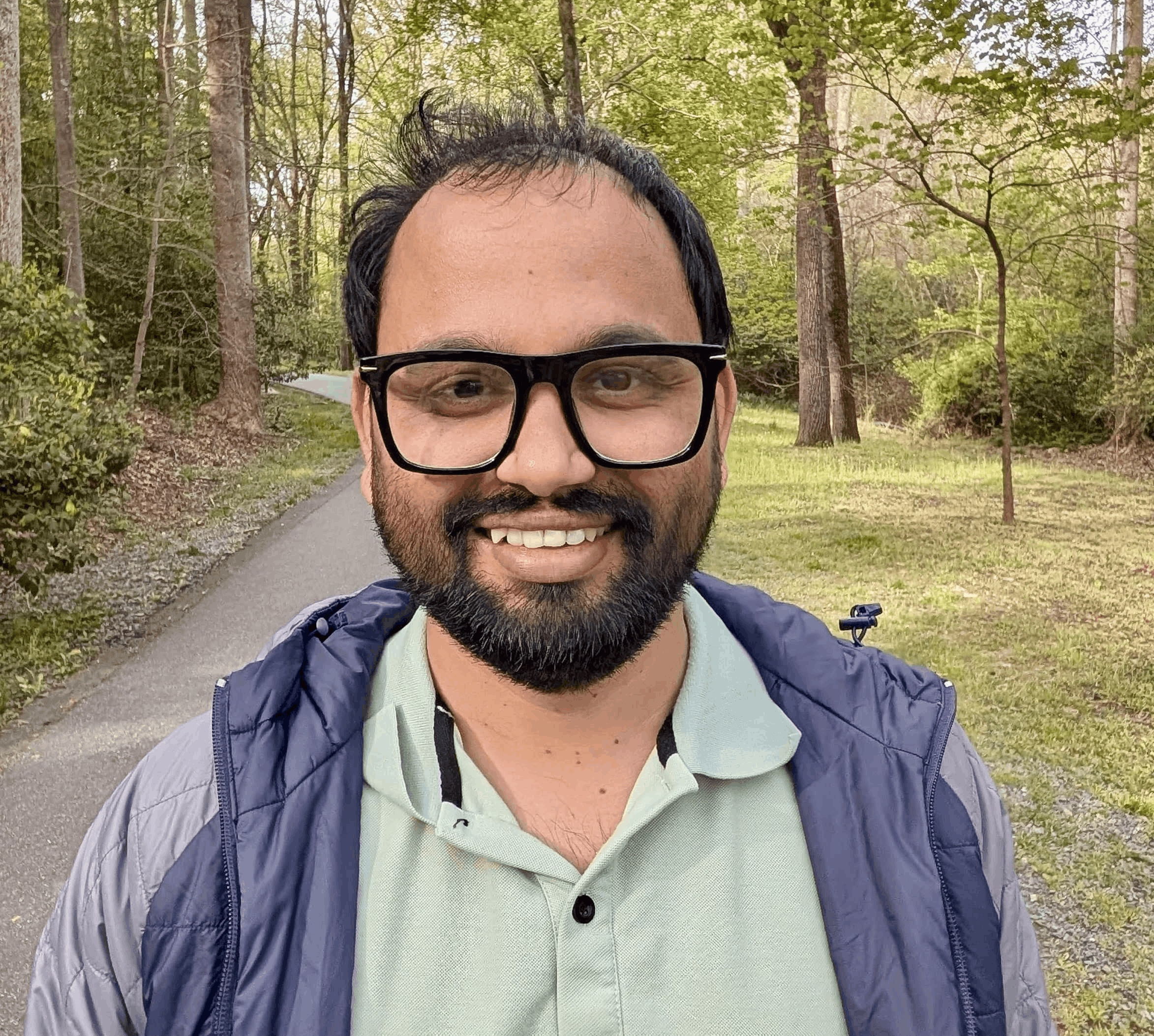
Pictured Left:
Physics PhD graduate Ramesh Dhakal.
During his postdoctoral work at Caltech, Dhakal plans to expand this research to study nonlinear spin–phonon interactions and their role in decoherence processes in spin qubits. Understanding and controlling these effects is an important challenge in the development of reliable quantum technologies and future quantum computing systems.
“This fellowship means a great deal to me,” Dhakal said. “This support gives me the freedom to pursue independent research directions that I am truly excited about. It is also a meaningful recognition of my work and an encouraging step toward developing my own research identity.”
Dhakal also credited his PhD advisor, Steve Winter, as one of the biggest influences on his academic journey. He noted that working on excitations and spin–phonon coupling introduced him to a rapidly growing area of condensed matter physics that bridges theoretical and experimental research.
“Working on these problems taught me how exciting it can be to explore questions that are both fundamentally interesting and relevant to emerging technologies,” Dhakal said.
Looking ahead, Dhakal hopes to build a long-term career in academia through research, teaching, and mentorship while continuing to investigate challenging questions in theoretical materials physics. He also emphasized the importance of supporting and mentoring future students as part of his long-term goals.