
From the 2017 Physics Alumni Newsletter
STATEMENTS FROM SOME FACULTY MEMBERS
Paul Anderson
This past year has had a good mix of teaching and research. I adapted the technique of the partially flipped classroom to an upper level course in quantum mechanics that I taught last fall. Inspired by Fred Salsbury, I had previously tried it the semester before in the undergraduate thermodynamics and statistical mechanics class. Most Fridays, the class was divided into four groups and each group elected a spokesperson. Then I gave the groups questions and problems to work out, and they reported their answers back to the rest of the class. It worked well and most students thought it was worthwhile.
Last winter, undergraduate Ray Clark joined our small research group. He is working with me on a project involving the computation of the energy density and pressure outside of a black hole that forms from collapse. He applied for and received one of WFU’s summer Undergraduate Research and Creative Activities grants which allowed him to spend most of the summer doing research. Ritchie Dudley is continuing to do interesting research on Bose-Einstein, BEC, analog black holes. The idea is that under certain conditions a BEC can mimic mathematically some of the properties that a black hole has. The advantage is that, unlike black holes, BEC’s can be studied in the laboratory, although the work Ritchie is doing is theoretical, not experimental. And, in February, a paper involving Eric Carlson, myself, and three former undergraduates: Jay Einhorn, Bradley Hicks, and Andy Lundeen, was published in Physical Review D. It involves a detailed study of possible consequences of quantum effects on the fate of the universe for various types of dark energy in many cases where classical general relativity predicts there should be some type of final singularity.
Keith Bonin
On June 30th I completed my last year (of 10) as Chair of the Department. Several significant tasks were completed during this final year. The conversion of Olin 105 into a novel format for teaching classes that are much more interactive was completed with the installation of a new laser projector and a new Google Jamboard for that room. I also chaired an important university committee that selected 4 new faculty members as the founding members of Wake Forest’s new Engineering Department. The new Engineering Department will start offering their first classes this fall at Wake Downtown. On the research side, I was issued my first patent (along with fellow Physics Professors Martin Guthold and Jed Macosko) for a new method to do high-throughput drug discovery using next-generation sequencing chips. Dr. Guthold and I also received a small internal grant this year to pursue this drug discovery idea in a different NGS platform, made by Illumina Corporation, the largest supplier of such machines. In addition, I submitted a paper on a new method for studying diffusion of DNA in cell nuclei that utilizes so-called structured illumination of cells, and this method enables measurement of the movement of DNA at a large matrix of points within the nucleus. This work is focused on developing techniques to better understand how to treat cancers without having the treatments themselves produce additional cancers. This coming academic year, I will be on academic leave to pursue research in several areas including the cancer and drug discovery research already mentioned, as well as research in optogenetics and also on cellular structural mechanics.
Carroll Research Group:
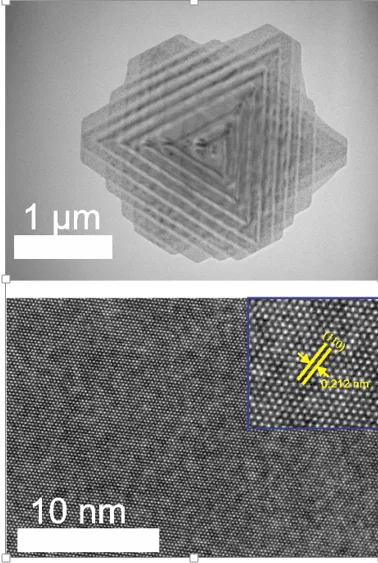 The research team of Prof. Carroll continues to push the boundaries in light emitting devices. With several new publications on AC magnto-transport in light emitting polymers, the group has been asked to present their work at several international forums. In the area of organic hybrid thermoelectrics, the Carroll team has also published significant new results. The group’s announcement of a fully flexible, textile, composite that exhibits a ZT quality factor of 0.97 (a world record), means that clothes made from such composite textiles would be capable of generating several Watts/m2 from just a light stroll. However, among the biggest moves made by the Nanotech group this year is setting its course into areas of quantum information processing. The team’s newest path has taken them into the world of two-dimensional dichalcogenides and the creation of the first gradient-doped topological insulators. Such materials have conductive surface states that are protected by fundamental symmetries such as charge and parity in their wavefunction. This is thought to allow for the entanglement of electronic states on topologically complex nano-objects such as shown in the image above. If the team is right, this means that electronically gated and fully integrate-able Qbits, operating at room temperature, are just around the corner! This work was carried out at the Wake Forest University Center for Nanotechnology and Molecular Materials.
Gregory Cook
The detection of new gravitational wave by the LIGO observatories continues. After two observations during the 2015-16 academic year, a third binary black hole coalescence detection was made this year, not long after the detector sensitivity was upgraded. This is quite an exciting time for gravitational physics. While I don’t participate directly in the observations, my work modeling black-hole binaries has played an important role. I was gratified to be invited to the Physics Department at Ole Miss University to give a talk on the history of binary black hole simulations and detections.
This was the first year in a very long time that I haven’t had a graduate student working with me. Two undergraduates have just started working on research projects that will carry through to next year. But, what I enjoyed most about this last year was getting to teach an advanced course in Computational Physics.
Eric Carlson
During 2016-’17, Eric Carlson has continued his research in semi-classical gravity. He published one paper with Paul Anderson and with former students Jay Einhorn, Bradley Hicks and Andrew Lundeen on “Future singularities if the universe underwent Starobinsky inflation in the past.” [Phys. Rev. D 95, 044012 (2017)]
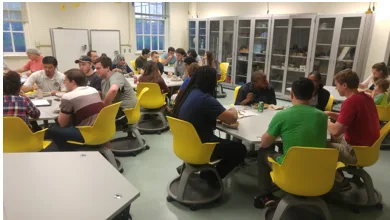
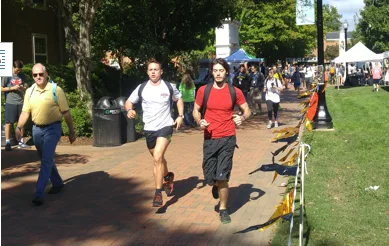
He has also continued to serve as the advisor for the Society of Physics Students. SPS had a lot of activities, including an overnight at Fancy Gap, participating in Hit the Bricks, a hike at Fancy Gap with SPS from Guilford College, and a year-end SPS picnic and Fermi contest. The honor society Sigma Pi Sigma inducted twelve new members, and Brian Conrad, the national head of SPS and Sigma Pi Sigma, was able to be present and participate in the induction ceremony
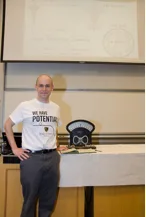
Martin Guthold
 There is quite a bit of exciting news from the Guthold lab, and its current, and recently graduated members. Xinyi Guo (PhD, 2015; Master of Accountancy, 2017) landed a job as a consultant at Deloitte in New York; Wei Li (PhD, 2015), who is now a post-doc in the Barker lab (UVA), got married this year (congratulations!), Stephen Baker (PhD, 2015) landed a great post-doc position in the Ariens lab at the University of Leeds, and Tommy Lucioni (BS, 2016) is attending medical school at Wake Forest University. Justin Sigley (PhD, 2014), visited the department in Sept. 2016 to give the Physics Colloquium. Elizabeth Gianino (BS, 2017), who wrote her Honors thesis about a permeability assay for blood clots, will be attending graduate school at Clemson University. Charlotte Antoni (BS 2017), who developed an assay to determine fibrinogen concentration, is planning to go to medical school, and Daniel Nelli (BS, 2017), who worked on several projects was accepted at Stanford University, though he is first taking a gap year in Utah visiting with his brother Patrick (BS, 2009). In March 2017, Amanda Smelser, who was a post-doc in the lab, accepted a post-doc position with Pierre Vidi at Wake Forest University. In June 2017, Scott Smyre, who was a technician in the lab, started a Master’s program at the WFU Medical School. In their research, Amanda and Scott found that a small force applied to a cell before metaphase reverses mitosis. This a very interesting finding, as aberrant mitosis is implicated in many diseases.
This past year we welcomed several new members to the lab. Post-doc Amanda Smelser, technician Scott Smyre, graduate students Ali Daraei, Melissa Pashayan, and undergraduate student Mary Kinney joined in fall 2016. Undergraduate student Jacquelyn Sharpe and John Diaz-Silveira joined the lab in the spring of 2017. The new members had an immediate strong impact on research productivity, with some work already resulting in publications. We were also hosting a visiting scientist, Lukas Fiber from Germany. The new members joined continuing lab members Hyunsu Lee, Elizabeth Gianino, Josiah Low and Daniel Nelli.
All the hard work by the lab members resulted in several publications. The Guthold lab published papers in Scientific Reports, PLOS One, ACS Applied Materials & Interfaces, and Acta Biomaterialia. Our new state-of-the art combined Asylum MFP-3D-BIO atomic force microscope (AFM) and an Olympus IX73 inverted optical microscope is getting great use by numerous researchers. In our drug screening project – a collaboration with NanoMedica, LLC – we got a third patent, and we are having a conversation with Illumina, a large sequencing company that is interested in our technology.
The Guthold family is doing well. My wife, a lawyer for the city of Winston-Salem, is keeping the city out of legal trouble. Our daughter, Melissanthi, is starting high school, and our son, Alexander, started Kindergarten at Forsyth Country Day School. My son, Felix, is working as a PA in a Cardiology unit at a hospital in Stuttgart (Germany).
We hope to see you at homecoming, or just arrange a visit with us.
George Holzwarth
I continue to do research and work with undergraduate and graduate students in Olin. Particle tracking has been a unifying theme in my recent research. For example, we tracked endogenous particles (peroxisomes) in live mammary epithelial cells and analyzed the motions by Mason’s Generalized Stokes-Einstein theory to determine the viscous and elastic moduli of the cytoplasm, a method called “passive microrheology” because the particle motion is thermally driven (Amanda Smelser, PhD 2017). Current research is directed at learning whether chromatin near double-strand breaks in DNA is more mobile than chromatin which has not been damaged (collaborators: Pierre-Alexandre Vidi, Cancer Biology, and Keith Bonin, Physics). My role is to determine mobility from the motions in live cells of photoactivated GFP fused to histone 2A. Another current project aims at determining how VSV (vesicular stomatitis virus) nucleocapsids move from the point of synthesis near the nucleus to the periphery of the cell (collaborators: Doug Lyles, Biochemistry, David Ornelles, Microbiology, Jed Macosko, Physics). The motions can be Brownian diffusion in random directions or motor-driven along microtubules or fibrous actin. We’ll use Bayesian statistics to segment the tracks into Brownian and motor-driven intervals. We’re currently seeking undergraduate students to work with us on these new projects.
Oana D. Jurchescu
The Jurchescu Research Group welcomed two new graduate students (Hamna Haneef and Colin Tyznik), and three undergraduate students (Laura Jennings, Ben Scharmann and Shengcheng Chen). Two undergraduate students defended their honor theses and graduated in May 2017. Jacori Hayes is now playing professional soccer at UC Dallas, and Angela Harper will start her master studies at Cambridge University in UK. Angela also won the first Churchill fellowship awarded to a Wake Forest student, and this fellowship will support her stay in UK. In addition, she won a graduate research fellowship from the National Science Foundation that will support her PhD studies at UC Berkeley upon returning from Cambridge. Graduate student Andrew Zeidell received a WFU Richter fellowship to travel to University of Bordeaux, France, where he was a visiting scientist in the lab of Prof Wantz, working on perovskite transistors.
Jed Macosko
In the Macosko/Holzwarth lab, we said goodbye to Amanda Smelser who successfully completed her Ph.D. in the summer of 2016 and was hooded this May. We also said farewell to Scott Smyre, who started in a master’s program on the medical campus. We are working hard on AFM-cell projects in collaboration with Dr. Guthold and a joint Ph.D. student (Melissa Pashayan) who is really great. We are also hoping to get some new undergraduates this fall and perhaps even a high school student (Dr. Macosko’s oldest child is finally in high school!) Our latest lab mascot is 11-month-old Bree Macosko, part Golden Retriever and part Spaniel. We are thankful for Kara Libby helping in the lab this summer and even taking time to give Bree some “good citizen” lessons, as she is otherwise pretty wild.
Fred Salsbury
The 2016-17 academic year was a busy one in the Salsbury group. The biggest news is that Ryan Godwin defended his dissertation and was also awarded the Outstanding TA award. He will be a visiting instructor in the Physics Department for 2016-17 and has started his own company. The past year was also a good year for publications and awards. We had eight publications come out with two more accepted including our first co-author paper with Dr. Berenhaut in statistics, thus lowering most of the group’s Erodős number to 4. Ryan Melvin had his T32 NIH fellowship from the Structural and Computational Biophysics training grant competitively renewed. Jiajie Xiao was awarded a fellowship from the Center for Molecular Signaling. A former undergraduate research student, William Thompson, won an NSF graduate fellowship to support his PhD work at Yale; he was a co-author on two of those eight publications. In other news, Dr. Salsbury attended a workshop on integrating computation into the undergraduate physics curriculum, and looks forward to applying some of the lessons learned there.
Timo Thonhauser
I was on sabbatical for the academic year 2016/2017, which was made possible through a generous fellowship from the Simons Foundation. During this sabbatical I spent time at MIT and collaborated with local experts on improving the theoretical description of modeling materials on the computer. I also used the time to submit research proposals to national funding agencies, one of which meanwhile has been funded by NSF. In addition, I worked with three other WFU faculty to submit a Center Planning Grant to the provost, which has also been awarded. As a result, for the academic year 2017/2018, I am the planning director of the Center for Functional Materials, and will work with my collaborators to investigate the feasibility of fully establishing this center at WFU.